

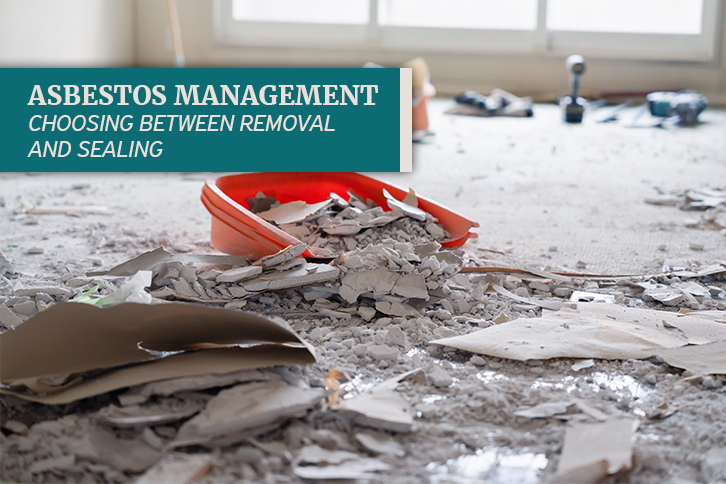
Asbestos remains one of the most dangerous materials found in older homes, schools, and commercial buildings. While it was once valued for being heat-resistant and durable, it’s now known to cause life-threatening illnesses such as mesothelioma when fibers are released into the air and inhaled by workers, product consumers, or other innocent bystanders.
Asbestos can splinter and break apart easily, such as from drilling, hammering, or wedging tools onto or near asbestos parts of a building. This sends sharp fibers into the air. These fibers can get trapped inside people’s bodies and cause cells to mutate into cancer.
If asbestos is discovered in a property, there are two approaches to address it: removal (abatement) or sealing (encapsulation). Both methods can reduce the risk of exposure, but they differ greatly in cost, safety, long-term effectiveness, and legal requirements.
In this blog, we’ll break down the key differences to help property owners make an informed decision.
What Is Asbestos Removal?
Asbestos removal, also known as abatement, is the complete elimination of asbestos containing materials (ACMs) from a building. This process is performed by licensed professionals who safely extract and dispose of the material following federal and state regulations.
Pros of Removal
- Permanent solution: Completely eliminates the material, reducing long-term liability.
- Safer for future renovations: There’s no risk of disturbing hidden asbestos during construction.
- Increases property value: Buyers often prefer asbestos-free structures.
Cons of Removal
- More expensive: Labor, disposal fees, and containment equipment drive up cost.
- Higher immediate risk: If mishandled, removal can release harmful fibers.
- Longer timelines: This requires permits, inspections, and professional oversight.
Removal is usually recommended when asbestos is friable – meaning it is crumbling and breaking apart – heavily damaged, or located in high-traffic areas where disturbance is likely.
What Is Asbestos Sealing (Encapsulation)?
Encapsulation involves covering asbestos-containing materials with a protective sealant binding fibers together and preventing them from becoming airborne. This may be done with spray sealants, rigid enclosures, barriers, or specialized coatings.
Pros of Encapsulation
- Lower cost: This is often less expensive than full removal.
- Less disruption: It is a faster process with fewer permitting requirements.
- Safe when material is intact: Encapsulation works well for asbestos that isn’t being disturbed.
Cons of Encapsulation
- Not permanent: This may require ongoing monitoring and future removal.
- Limits future construction: Encapsulated asbestos can interfere with remodeling.
- Risk if seal is breached: Damage or aging can re-expose fibers.
Encapsulation is typically recommended when the asbestos is intact, stable, and unlikely to be disturbed in the near future from repairs or renovation work.
Legal Requirements & Safety Considerations
Due to health risks, asbestos work is heavily regulated at federal, state, and local levels. Homeowners, tenants, building managers, and maintenance workers should commit to the following:
- Avoid DIY handling.
- Hire licensed asbestos professionals.
- Follow proper disposal laws.
- Obtain required permits, especially for commercial buildings.
Even encapsulation should be evaluated and completed by certified experts.
Final Thoughts
Both asbestos removal and encapsulation can be effective, but the right choice depends on the condition of the material, future renovation plans, long-term health of the area of the building, and financial considerations. Encapsulation offers a cost-efficient temporary fix, while removal provides a complete, permanent solution, especially when damage or disruption is likely.
If asbestos is discovered in your home or workplace, consult a certified asbestos professional to assess the condition and provide a tailored safety plan.

Categories: