

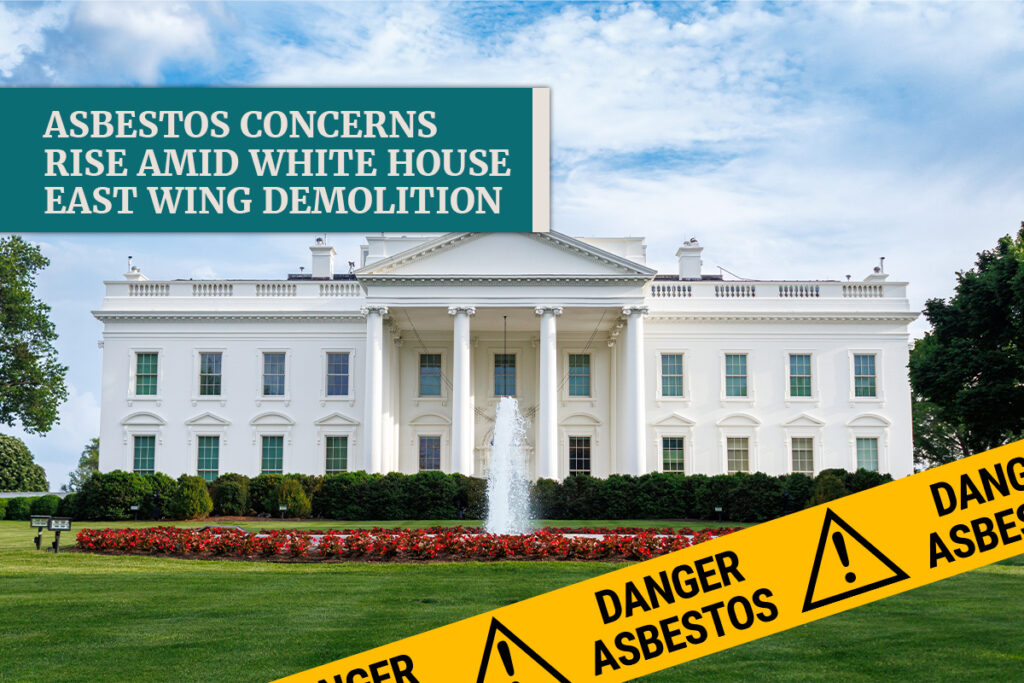
The recent White House East Wing demolition has drawn national attention — and concern — as reports surface about potential asbestos exposure and contractor liability. Lawmakers, advocates, and safety experts are questioning whether proper asbestos abatement and Occupational Safety and Health Administration (OSHA) regulations were followed during this high-profile construction project.
Background: A Historic Building with Modern Risks
The East Wing, built in 1942, was constructed during a period when asbestos materials were widely used in insulation, flooring, and roofing. In late October 2025, the building was torn down to make way for a new 90,000 square-foot ballroom.
However, multiple reports — including from ABC News and The Washington Post — note that no public record confirms asbestos inspection or removal took place before demolition began. Questions have also been raised about whether the contractor held a valid asbestos-removal license in Washington, D.C.
For workers, construction crews, and nearby staff, this lack of transparency raises serious concerns about potential toxic exposure and the long-term health risks associated with inhaling asbestos fibers, including a cancer called mesothelioma.
Lawmakers and Advocates Demand Answers
Senator Edward Markey and several members of Congress have requested documentation from the White House and its contractor, ACECO, to verify compliance with federal asbestos safety laws. In a press statement, Senator Markey described asbestos as “one of the most hazardous occupational and environmental health risks,” calling for full transparency in the asbestos abatement process.
Advocacy organizations such as the Asbestos Disease Awareness Organization (ADAO) have also weighed in, urging federal officials to ensure that proper worker safety protections and air-quality monitoring were in place during the demolition.
Contractor Liability and Legal Exposure
According to Engineering News-Record (ENR), contractors involved in the White House East Wing demolition could face significant legal and compliance risks if asbestos-containing materials were disturbed without proper inspection, notification, or removal. Under Environmental Protection Agency (EPA) and OSHA asbestos regulations, companies must conduct an asbestos survey before demolition and remove any identified materials through licensed abatement contractors. Failure to do so can lead to costly fines, lawsuits, or even criminal penalties.
This case underscores the importance of construction law compliance — even for projects on federal property. Contractors, subcontractors, and government entities must document every step of asbestos abatement, provide worker protection, and ensure safe handling of debris to avoid occupational safety and environmental law violations.
Why This Matters
The White House project is a reminder that asbestos exposure remains a major workplace safety and public health concern — even decades after the material was banned in most applications.
For individuals and families affected by unsafe construction practices or toxic exposure, understanding your legal rights is critical. At BCBH Law, our attorneys represent workers and citizens harmed by asbestos negligence, unsafe job sites, and environmental non-compliance.
Whether it’s a residential property or a federal landmark, asbestos safety isn’t optional — it’s a legal and moral obligation.
What Happens Next
Lawmakers continue to push for full documentation of the East Wing demolition, and oversight hearings are expected to follow. Potential lawsuits or enforcement actions could arise if investigations reveal violations of EPA or OSHA regulations.
Contact BCBH Law
If you or someone you know believes they may have been exposed to asbestos or harmed by unsafe demolition practices, our attorneys can help. BCBH Law has extensive experience in construction law, asbestos exposure claims, and occupational safety cases.
- Critics question whether White House, contractors 'cut corners' on asbestos safety in East Wing demolition. ABC News Retrieved from: https://abcnews.go.com/US/critics-question-white-house-contractors-cut-corners-asbestos/story?id=127001299. Accessed: 11/07/2025.
- Senators, advocates demand explanation on asbestos risks from East Wing. The Washington Post. Retrieved from: https://www.washingtonpost.com/politics/2025/10/30/east-wing-demolition-asbestos-abatement/. Accessed: 11/07/2025.
- Contractor Compliance Risk Mounts for Firms in White House East Wing Demolition. Engineering News-Record. Retrieved from: https://www.enr.com/articles/61797-contractor-compliance-risk-mounts-for-firms-in-white-house-east-wing-demolition/. Accessed: 11/07/2025.
- White House East Wing Demolition Sparks Concern Over Asbestos Safety and Transparency. Asbestos Disease Awareness Organization. Retrieved from: https://www.asbestosdiseaseawareness.org/newsroom/blogs/white-house-east-wing-demolition/. Accessed: 11/07/2025.
- Senator Markey Grills White House Contractor ACECO on Health and Safety Precautions During East Wing Demolition. Sen. Edward Markey. Retrieved from: https://www.markey.senate.gov/news/press-releases/senator-markey-grills-white-house-contractor-aceco-on-health-and-safety-precautions-during-east-wing-demolition. Accessed: 11/07/2025.

Categories: